Wednesday, February 27, 2013

Checkmate

It's been 9 years since Facebook launched in 2004.

Over that time, Facebook has cited itself at a gathered number of 1.06 billion users.
Some will say this summoning of the global village is a good thing.
I'm going to say it's bad.

As a social tool, Facebook is great. You can stalk keep in touch with your friends, stalk check out what your employees are doing, stalk check out where your friends are going on vacations and, more importantly, for all of the parents out there you can stalk keep an eye on your children.

And did I mention you can stalk keep in touch with people?

Here's a cool thing to say to non-social media users:
"If you don't want Facebook because you think it's bad, then don't have it."
Well, according to Facebook, 1/3 of the Internet-using world (and 1/2 of America) has a Facebook page, and according to their growth statistics, they have no intention of slowing down. This means that for every 1/3 of your real-world friends that have access to Internet, there's a chance they'll say, "Hey, check out my photos from vacation last week... Wait, you can't do that because you don't have a social media profile? Well, sign up for one!" Peer pressure. 1/3 of a world is a lot of pressure to hold back.

Another problem with not having a social media account is that at this point in time, they're almost required.

Do you want to apply to a new job that has anything closely related to social media? You'd better be able to use social media (usually Facebook).
Some jobs even require their employees to be linked in with Facebook.

Now, I can completely see how social media is a great utility for the world to get connected. In fact, I'll say it's a requirement for humanity to continue its rapid growth, but Wikipedia is a great utility, and it's lacking something that most social media outlets have... advertisements.

Facebook has even started placing advertisements in its newsfeed based upon what people have previously posted! Here's something my brother sent to me the other day:

I recently posted about my brother's new children's book on Facebook. A day or two later, he sends me a message asking if I sponsored his book.
Facebook used my post as an advertisement for his book, and I didn't even have a choice to opt-in or out of it!

Imagine if I had shared a link to something that could potentially damage my reputation if it were shown as an ad.

Now, of course there are more options out there than Facebook, and each platform has its own functions; but unless you want to set up your own social media platform like Elgg, you're stuck with a choice that has other users and, y'know, is actually social.

Monday, February 25, 2013

Myo my!

The Myo is probably the coolest gadget to hit the market in the past few days, I'm compelled to say that it's even upstaged the Google Glass project.


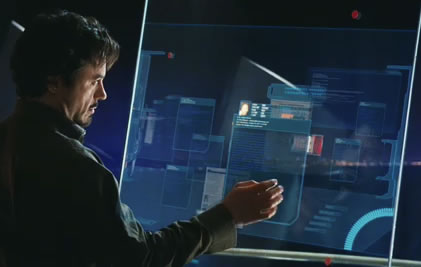
Why is the Myo such a great invention? Think about Iron Man (or any tech movie) for a second:
Tony Stark is able to directly interact with his technology.
But we already have touch screens!
We might have interactivity with 2D objects, sure, but what about 3D objects, like when Tony is interacting with his newly discovered element in Iron Man 2?
The Myo brings electronic interactivity to a whole new level. A major issue with current interactivity is learning how to interact with objects.

But the Myo changes everything when it comes to learning how to interact with objects. When 3D technology develops far enough, why shouldn't we be able to push a virtual object around? We should, using the Myo, people will be able to grab digital items. Want to empty your Computer's trash? Grab it from your desktop, tilt it upside down, and literally empty it! Want to fly a real remote helicopter? Pretend you're holding the bottom of it, or pretend your hand is the helicopter, and control it as such.

The limits are practically endless with the Myo, and it's still in production. Preorders can be made at Myo's website for $159, and they've even made a handy-dandy list of FAQs for people who conveniently have Frequently Asked Questions to ask.

Wednesday, February 20, 2013

Auto Tube Review

It slices... it dices... it... automatically creates articles on your Joomla! website from a YouTube channel?

Meet AutoTube, a Joomla! extension that is able to make any web-specialist's work a lot easier.

Essentially, AutoTube follows a very simple workflow:

  1. Install AutoTube
  2. Give AutoTube's settings the YouTube Channel you want it to pull videos from
  3. AutoTube will make articles using video's titles, description, and it will embed a playable version of the video.
Pretty great, eh? But you were looking for a bit more power than just that. Unfortunately, AutoTube may not have all of the Bells'n'Whistles ®, but it does have some powerful features, I've screen cap'd them for you:

The settings are where the bad news comes in:
  • You can only select one channel to load videos from
  • You can't add more instances of AutoTube to your Joomla! install
  • You can't set AutoTube to load only public, private, or unlisted videos from a channel
  • You will need to configure any WYSIWYG editors in Joomla! to not filter HTML while editing
But why should these cons matter? It's free, right?
Oh, by the way, it costs $44, and that's on sale. 

For a professional in the web field using Joomla!, anything that saves as much time as AutoTube does is probably worth shelling out the $44 to buy it. 
AutoTube's developer has also responded to all of my emails within a day, which is also a good sign when looking to buy a long-lasting extension. 

While this extension could be better, it does a fantastic job at getting content from YouTube on to your website, which saves a lot of time for multimedia organizations. Due to its ease of use, but lack of powerful features, AutoTube gets 4/5 cats:


Monday, February 18, 2013

Hello, world!

Imagine a desk full of pens that all look the same. The only issue with all of the pens in this desk is the fact that some of the pens write like pens, others write like pencils, and some write like crayons.

As simple as it may seem, design goes a long way in determining how we, as humans, interact with symbols or objects.

That's what one of my majors, web design, is all about: giving an inanimate object a certain look and feel for users to interact with. 

After all, computers aren't natural: humans aren't born with an instinctive ability to just walk up to an electronic device and inherently know that in order to use it. How would anyone know that devices need to have power, and more importantly, how would someone who has no knowledge of electronics know there is a certain way to interact with it?

Enter design, and not just any design, but good design. Back when then Internet was first becoming publicly available, there were sites like CERN's, and many more. But even with basic HTML (webpage) formatting, these sites are able to convey meaning to users. For instance, on CERN's early site, most of the page is simple text... and then there are these random blue words on the page. What? Why would words randomly be different colors, and why would they be underlined? It's all because of design: the differently colored elements draw attention and let users know how to interact with themselves.

But these design strategies didn't always work. In fact, there were (and still are) classes teaching people how to use the Internet. The only problem with teaching a class on how to use the Internet is that if the class is being taught on the Internet, how can people be expected to use it?

So... if there are good website designs, are there bad ones? Hello, yes. There are actually websites dedicated to the worst websites in existence

Essentially, bad web design practices are the number one reason I am pursuing my majors. I know that bad design can never be completely removed from the Internet, but with enough work, I know it is possible to make tools and content management systems that teach users how to properly create websites.

But why does bad design matter? Why should anybody care if there are people with old sites out there that are hard to use? 
Unfortunately, to me, there is no black and white answer. But if there are individuals who make one bad site, and then help a friend make a site, who helps make another friend make a site, pretty soon there are hundreds of thousands of websites with bright-lime-green font over a white background, or even worse, a white font on a white background, while site visitors are having seizures because of the bright colors.
Of course, my example is a bit of a long shot, but I've seen too many sites like my example to not care.

With time, web designers will increasingly emerge from school with their toolbelts of good design, but for now, we'll just have to keep working at making the web a better place.